.png)
Brand health is an indicator of a brand's strength and appeal, reflecting how well it connects with its intended audience and differentiates itself from competitors. A healthy brand consistently maintains a positive reputation, establishes a deep relationship with consumers and delivers on its promises, contributing to long-term business success. Tracking and improving brand health is important for businesses navigating today's complex market dynamics and needing to adapt to changing consumer behaviour to secure a competitive advantage.
This article draws on insights from Jenni Romaniuk's book Better Brand Health and from our experience working with clients across different industries. It explores five reasons why measuring brand health matters:
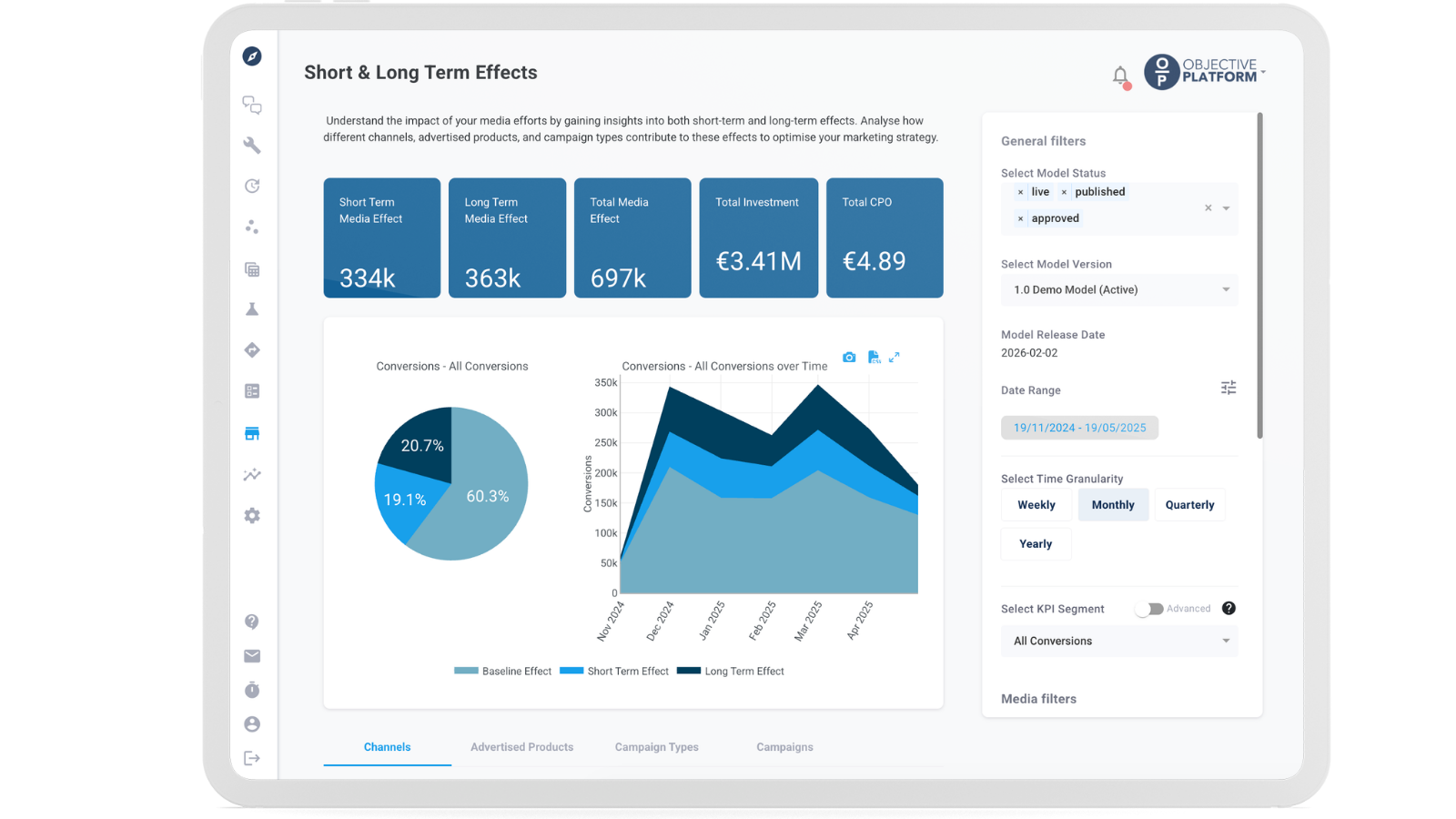
At Objective Platform, we built the Short and Long-term Effects dashboard within the Brand Insights module specifically to address this challenge. It helps identify which channels excel at driving immediate results and which are most effective for sustained brand building.
Brand value, whether measured by brand consideration, ad awareness or a custom brand KPI, amplifies both baseline sales and media effectiveness. The dashboard reveals these temporal dynamics across different media breakdowns, including channel, advertised product, campaign types and individual campaigns. It clearly shows how some media channels deliver strong immediate results while others create significant long-term value through enhanced brand strength, helping inform strategic planning for cross-media investments.
When an advertiser launches a TV branding campaign, the immediate sales uplift might seem modest relative to the investment. The Short and Long-term Effects dashboard shows the fuller picture: the campaign also strengthens the brand's position with the target audience, making future performance campaigns more effective. For a worked example using real data from the Short and Long-term Effects dashboard, see Brand vs Performance Marketing: How to Find the Right Investment Split.
There is a significant risk of missing opportunities when focusing only on the immediate results of performance marketing campaigns without considering the broader, long-term brand impact. This narrow focus can lead to a distorted perception of which channels deliver the best return on investment.
If you focus only on the short-term effects of a specific campaign, search advertising might seem to offer the highest immediate ROI because of its direct impact on sales. Viewing the same campaign from a long-term perspective reveals that TV advertising, because of its brand-building capabilities, drives substantial sales well after the campaign has finished.
This delayed effect highlights the importance of considering how the visibility and influence of TV advertising accumulate over time, contributing to sustained brand recognition and increased sales long after the initial advertisements have aired.
Without measuring the long-term effect, organisations may undervalue channels like TV that are crucial in cultivating lasting brand consideration and loyalty.
.png)
Making your brand the first option customers think of is particularly important in industries where purchase decisions are infrequent. Subscription services, such as the internet packages that telecom providers offer, are a good example.
By focusing on building a strong brand, you can ensure that when customers are ready to buy, your brand is at the top of their minds. This matters because in most categories, only a small fraction of potential customers are actively looking to purchase at any given moment. In telecoms, for example, most consumers are not looking for a new internet provider today. They are locked into existing contracts, satisfied with their current service or simply not thinking about it. Brands that maintain strong brand consideration scores are disproportionately likely to be chosen when that moment of active consideration finally arrives.
A key benefit of maintaining strong brand health is its ability to withstand price changes without affecting its value or position in the market. Research from Les Binet and Peter Field's The Long and the Short of It reveals a critical analysis of the effects of different marketing tactics on pricing strategy.
Discount promotions like coupons and direct marketing can boost sales in the short term, but they also make customers more price-focused. This focus on price can weaken brand value over time.
The experience of Tyrrells, the premium crisp brand owned by KP Snacks, illustrates this clearly. Facing a race to the bottom in the hand-cooked crisp category, the brand had fallen into a cycle of price promotions that pushed the price per pack below £1 and the business was losing money. Consumers liked the product but were not prepared to pay a premium for it.
In 2019, KP Snacks made the decision to move investment from trade promotions into brand building. They raised prices by around 30% and launched a distinctive brand campaign across TV, print and digital. The immediate effect was a sharp drop in volume sales — a moment their global marketing controller Dan Winslet described as a real test of conviction. But the long-term result was growth: Tyrrells grew its share of the premium sharing crisps market from 12.6% to 15.3%, as reported by Marketing Week.
The Tyrrells story demonstrates that brands with strong health can make pricing decisions that would be impossible for a brand that has trained its customers to wait for promotions. Brand-building investment is what creates that pricing power.
Improved brand health significantly improves the effectiveness of performance marketing campaigns, resulting in a higher return on investment. A healthy brand includes recognition, trust and positive associations in the minds of consumers. When people recognise and trust a brand, they are more likely to respond positively to performance campaigns, including promotions and new product introductions.
This recognition and trust mean that performance campaigns can be more efficient, as they do not need to spend time and resources re-establishing the brand's value. Marketing budgets are therefore used more effectively, leading to higher conversion rates and lower cost per acquisition.
Nike's recent experience illustrates what happens when a major brand moves in the opposite direction. Under its previous leadership, Nike shifted heavily towards direct-to-consumer and performance marketing while reducing investment in brand building. Constant discounting cheapened the brand's premium positioning and the business lost ground to newer competitors. Revenue declined significantly over several consecutive quarters and the brand's share price lost a quarter of its value during 2024, as covered by Marketing Week.
The turnaround began when new CEO Elliott Hill took over in late 2024 with a clear mandate: return to brand-first marketing. Nike increased brand marketing investment, pulled back on promotional discounting and refocused on sports partnerships and athlete associations. Early results show Nike's running division returning to growth as brand health begins to recover. The lesson for any marketing team is that performance efficiency does not exist independently of brand health. When brand metrics decline, performance campaigns have to work harder and cost more to generate the same results.
As performance marketing measurement becomes more complex, brand health measurement fills an important gap by making the value of brand investment visible and defensible to finance teams.
This matters particularly when budgets are under pressure and brand marketing is the first line item to be cut, usually because the immediate impact of reducing brand spend on sales is not immediately visible. However, by examining the total effect of media across both short-term and long-term impacts, a clear pattern emerges: when brand marketing budgets are cut, brand health and eventually sales decline over time.
By demonstrating the return on investment for brand spend, marketing teams have a strong case to present to the CFO. This is not just about protecting the current budget, it is about demonstrating the long-term value of investing in brand health. With this approach, brands can remain strong and financially backed even when conditions are difficult.
Measuring brand health is not an optional layer on top of performance measurement. It is the foundation that explains why performance results look the way they do. Understanding brand consideration levels, the long-term effects of media investment and the relationship between brand strength and performance efficiency gives marketing teams the evidence they need to plan strategically, defend budgets and optimise across both timescales.
If you want to understand how the Short and Long-term Effects dashboard within Brand Insights can help your organisation measure and act on brand health, get in touch with the Objective Platform team.
What is brand health and why does it matter?
Brand health is a measure of how well a brand connects with its intended audience, how positively it is perceived and how strongly it differentiates itself from competitors. It matters because brand strength directly affects how efficiently performance media converts, how much organisations pay per acquisition and how well their media budget works overall. A brand with strong health generates more sales from the same media investment than a brand with weak health.
How do you measure brand health?
Brand health is typically measured through a combination of brand KPIs such as aided awareness, brand consideration, ad recall and net promoter score. These metrics are tracked over time, often through consumer surveys, and can be integrated into a Marketing Mix Model to understand how media investment is moving brand metrics and how changes in brand health affect performance campaign efficiency.
What is the difference between brand health and brand awareness?
Brand awareness measures whether consumers recognise or recall a brand. Brand health is broader: it encompasses awareness but also includes consideration, loyalty, perceived quality and emotional associations. A brand can have high awareness but poor health if consumers recognise it but do not prefer it or trust it.
How does brand health affect performance marketing?
Brand health acts as a multiplier on performance media efficiency. When brand consideration is above a certain threshold, performance campaigns convert more efficiently and at a lower cost per acquisition. When brand health declines, performance campaigns have to work harder to generate the same results, increasing cost per order. This relationship is measurable using Marketing Mix Modelling and is visible in the Brand Insights module within Objective Platform.
How do you prevent brand budget cuts?
The most effective way to prevent brand budget cuts is to make the return on brand investment visible and defensible. This means measuring both the short-term and long-term effects of brand spend, quantifying how brand health affects performance campaign efficiency and presenting this evidence to finance teams in terms they understand. Marketing Mix Modelling, and specifically the Short and Long-term Effects dashboard within Brand Insights, provides this evidence in a format that supports CFO-level conversations.