.png)
The brand versus performance debate is often framed as a choice, but the real question is proportion. Research consistently shows that brands which invest too heavily in short-term performance at the expense of brand building end up paying more for each conversion over time, as brand strength directly affects how efficiently performance media works. Finding the right split requires measurement, not instinct, specifically understanding the tipping point at which your brand KPIs start to positively or negatively affect your media performance results.
When planning media budget and juggling overall marketing objectives, you're faced with a crucial choice: should you invest in brand or focus on performance campaigns?
Performance campaigns generate immediate results e.g. traffic, conversions, sales. Brand campaigns build the conditions that make those results easier and cheaper to achieve over time. The challenge is that the two timelines are very different, which makes it hard to weigh them against each other in a budget conversation.
This post covers the main challenges of finding the right split, how to use data to identify your brand's tipping point and what to expect when you increase brand investment.
Finding the right balance between short-term sales activation and long-term brand building is one of the most common challenges we see. Invest too much in performance and you get short-term sales spikes that fade quickly, without the brand recognition and loyalty that sustain growth over time.
Adding to this challenge is the struggle to clearly show the value and financial return of investing in brand marketing. This is precisely where Objective Platform can help, by making the ROI of brand marketing measurable and helping you determine the ideal split between brand and performance campaigns.
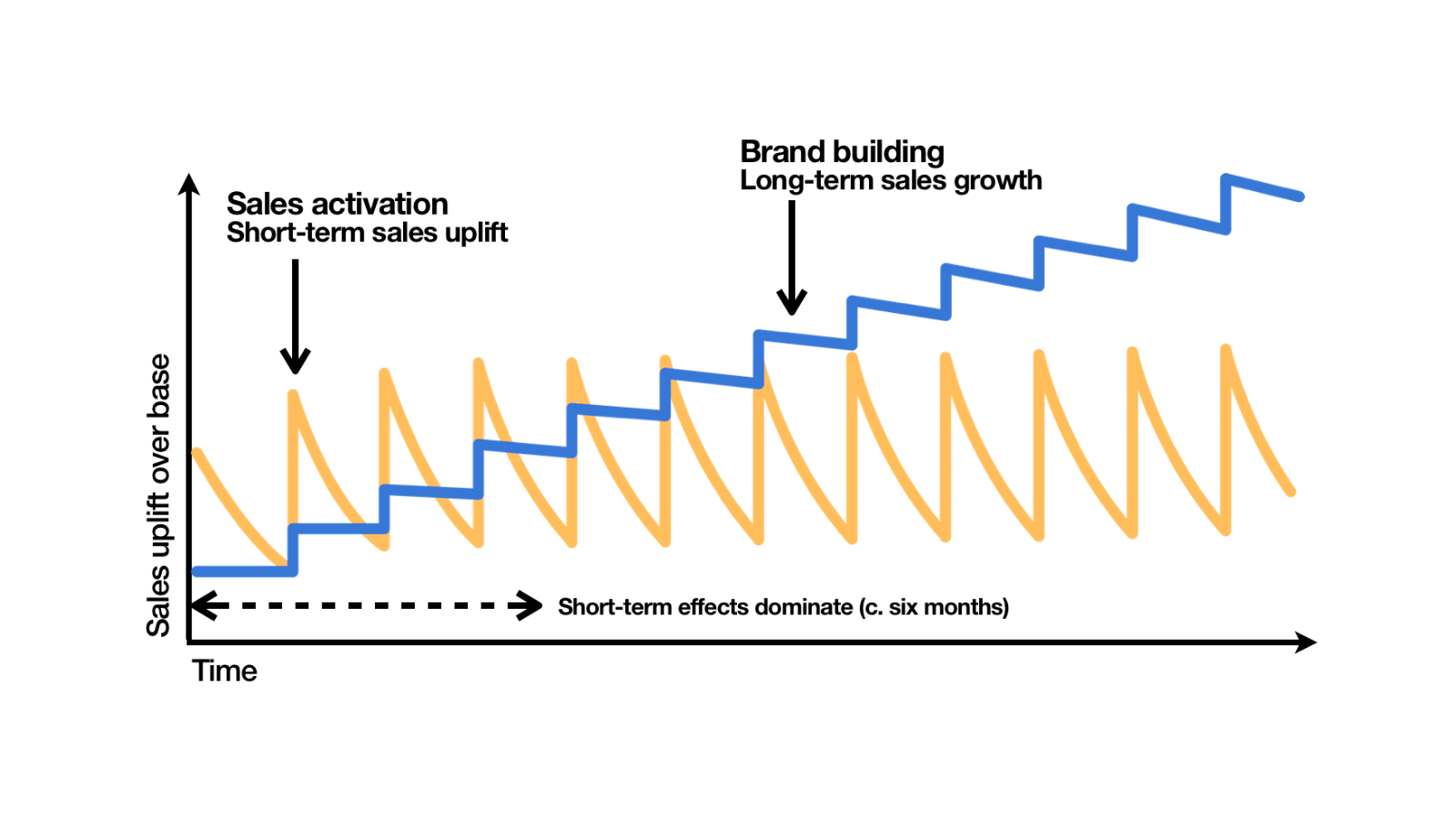
Focus too heavily on brand and you delay immediate results. The key question is not which one to choose, but what proportion serves your brand's specific situation. Answering this requires data, not intuition, and specifically data that connects brand KPIs to media performance outcomes.
The Brand Insights module within Objective Platform was built to answer exactly this question. Our dashboards provide a measurable, evidence-based approach to budget decisions, with two key features: Brand Attribution Insights and Short- and Long-term Effects.
Performance marketers traditionally rely on data-driven decisions, while brand marketers often depend on intuition. The Brand Insights module seeks to close this gap by offering insights into key areas:
Our Brand Attribution Insights dashboard offers a comprehensive view of brand campaigns, brand KPIs and their outcomes. This gives marketing and brand managers the data they need to make decisions based on evidence rather than gut feeling or industry benchmarks.
To show how this works in practice, here is a worked example using real data from the Objective Platform Brand Insights module.
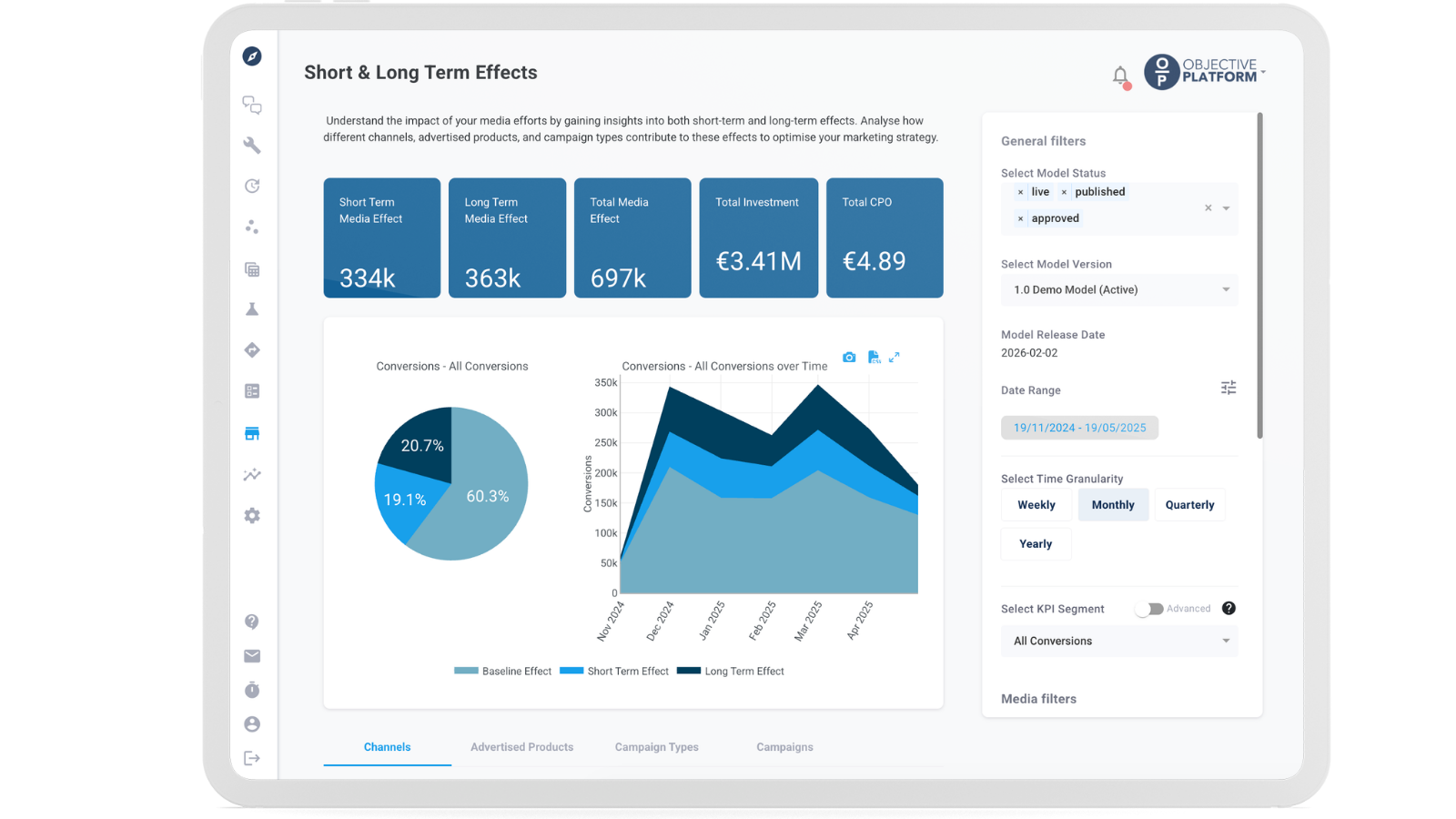
A Marketing Manager at a multi-brand organisation with a total media investment of €3.41M is reviewing her annual budget distribution. She opens the Short and Long-term Effects dashboard and sees something immediately worth investigating.
Of total conversions generated in the period, 60.3% came from baseline, organic demand that exists regardless of media. Short-term media effects accounted for 19.1% of conversions, while long-term media effects accounted for 20.7%. In other words, long-term brand-building effects are already marginally outperforming short-term activation, despite the organisation historically weighting budget towards performance.
Drilling into channels tells an even clearer story. TV generated 288,939 conversions across the period, more than three times the next highest channel, Radio at 74,619. The relative split between short and long-term effects shows that TV and Radio are disproportionately long-term in their impact, while digital performance channels like DV360 Retargeting and Google Branded Search skew heavily short-term.
.png)
Bar charts showing short versus long-term effect per channel, with TV generating 288,939 conversions as the highest performing channel. She then switches to the Brand Attribution Insights dashboard to understand how media investment is actually moving brand metrics.
Average brand consideration stands at 25%. Media is responsible for 7% of that and the remaining 18% comes from non-media and other factors. Looking at this by campaign type tells a clear story: always-on campaigns deliver 7.57% brand uplift per €100k invested, branding campaigns deliver 5.57%, and performance campaigns deliver just 1.05%.
.png)
The Effect of Brand on Sales tab shows a direct relationship between brand consideration levels and media performance efficiency. At 29.80% brand consideration, the model shows a -0.07% multiplier on base performance, effectively the breakeven point. Drop below this and every euro spent on performance media generates fewer conversions. Rise above it, starting at 29.90% where the multiplier turns positive at 0.34%, and performance campaigns begin to work more efficiently.
For this brand, maintaining brand consideration above 29.9% is not just a brand objective, it is the threshold at which media investment starts generating a positive return on base performance. Falling below it means paying more for the same results.
.png)
The practical implication is clear: running performance campaigns at low brand consideration levels is expensive. As brand consideration increases, the same performance budget generates more conversions at a lower CPO. This is the economic case for brand investment not as a separate objective from performance, but as the foundation that makes performance media more efficient.
The data shows that 29.9% brand consideration is the effective tipping point for this brand. The threshold at which the multiplier on base performance turns positive. Below it, performance media works against a headwind. Above it, each campaign benefits from improved baseline efficiency.
This means the immediate priority is not simply running more brand campaigns, but running enough brand activity to push and hold consideration above 29.9%. Once that level is maintained consistently, the benefits compound: performance campaigns become more efficient, CPO decreases and the same media budget generates more conversions.
The Always On campaign type is particularly effective here. At 7.57% brand uplift per €100k invested, it delivers the highest return of any campaign type for brand consideration, nearly seven times more efficient than performance campaigns at 1.05%. This makes it the most practical tool for maintaining brand consideration above the tipping point between larger brand campaign flights.
The brand versus performance debate does not need to be a debate. With the right measurement in place, it becomes a data question: at what level do your brand KPIs start to positively affect your media performance, and what investment is required to get there and stay there?
The example above shows that the answer is specific to each brand, each market and each set of KPIs. For this brand, the number is 29.9% brand consideration. Below that threshold, performance media is less efficient. Above it, every campaign works harder. Generic rules of thumb, invest 60% in brand and 40% in performance, are a starting point at best. What actually drives better decisions is understanding your own brand's tipping point.
If you want to understand where your brand sits and what investment is required to move it in the right direction, get in touch with the Objective Platform team.
You might also find these useful:
What is the right split between brand and performance marketing?
There is no universal answer. Research from Les Binet and Peter Field suggests that 60% brand and 40% performance is a useful starting point for many categories, but the optimal split depends on your brand's current strength, competitive position and category dynamics. The most reliable way to find the right split for your brand is to measure the relationship between your brand KPIs and your media performance outcomes.
How does brand investment affect performance marketing results?
Brand strength directly affects how efficiently performance media works. When brand awareness and consideration are high, consumers are more likely to respond to performance ads, which lowers your cost per conversion. When brand metrics fall below a critical threshold, performance campaigns become less efficient, meaning you pay more for the same results.
What is a brand KPI tipping point?
A brand KPI tipping point is the level at which a specific brand metric, such as Aided Ad Recall or brand consideration, begins to positively or negatively affect the efficiency of your performance media. Below the tipping point, media performance declines. Above it, performance campaigns become more efficient. Identifying this tipping point allows you to set a data-driven minimum threshold for brand investment.
How do you measure the ROI of brand marketing?
Brand marketing ROI is difficult to measure with click-based attribution because brand campaigns rarely generate direct clicks. Marketing Mix Modelling is one of the most reliable approaches, using historical data to isolate the contribution of brand activity to sales over time, including the indirect effect of brand strength on performance media efficiency.
What is the difference between brand building and sales activation?
Brand building refers to long-term investment in awareness, consideration and emotional associations that make a brand easier to choose. Sales activation refers to short-term campaigns designed to convert existing demand into purchases. Both are necessary, but they work on different timescales. Brand building creates the conditions for sales activation to work more efficiently.