.png)
Most marketing professionals know that showing the impact of their work to the business is rarely straightforward. Some areas come with clear performance metrics such as open rates, click-through rates and conversions. Others are far harder to define, including awareness, engagement, customer lifetime value and brand perception. When the metrics that matter are difficult to track, building a clear marketing strategy around them becomes harder too. This is part of why brand marketing and performance marketing so often end up working in silos, even though a healthy balance between the two delivers stronger results over the long term.
Share of Voice was built for a traditional media world and no longer captures brand building across digital channels like social and video.
Share of Search measures the organic searches for your brand as a proportion of all brand searches in your category, using free Google Trends data.
Les Binet's research found Share of Search works as a leading indicator of market share, giving up to a year of advance warning in some categories.
The metric only creates value when you act on it, connecting brand health to performance and using it to guide media budget allocation.
Brand marketers have long built their work on established theories, such as Byron Sharp's How Brands Grow or Effectiveness in Context: A Manual for Brand Building by Les Binet and Peter Field. The approach that follows tends to focus on reaching a target audience, tracking KPI performance through survey responses and measuring Share of Voice to understand brand position in the market.
Share of Voice has a clear limitation in a digital world. It was designed around traditional channels such as TV and radio and does not account for digital media like social and video. As a result, it no longer captures the full value that brand marketing delivers. Building a brand remains one of the things that determines whether a company succeeds, yet proving the long-term value and return of brand campaigns is still difficult.
Share of Search offers a way to measure brand health that fits the digital era. It takes the total organic searches for a specific brand and divides that by the total searches for all brands in the same category. The result is a percentage that shows how much of the category's search demand your brand commands.
Because the data comes from Google Trends, it is free to access, available at weekly frequency and stretches back as far as 2004. That makes Share of Search a fast and low-cost signal of brand health, without the lag or expense of traditional brand tracking surveys.
.png)
Marketing effectiveness expert Les Binet introduced Share of Search to a wide audience at the EffWorks Global 2020 Conference. His central observation was that online search data holds a great deal of information about brands, with Google acting as what he called the world's biggest database of human intentions.
To test the idea, Binet examined three categories with very different sales cycles: automotive, energy and mobile phones. In each one, he found that Share of Search correlated with market share and worked as a leading indicator of it. Movements in Share of Search tended to predict where market share would go next, in some categories giving as much as a year of advance warning.
Later research by James Hankins built on this. Across 30 case studies spanning 12 categories and seven countries, Hankins found that Share of Search accounted for around 83% of a brand's market share, which strengthened the case for using it as a practical proxy when market share data is hard to obtain.
Binet's findings point towards a full-funnel approach, where search data measures brand value at the top of the funnel and connects to performance metrics further down. This is what makes Share of Search useful beyond brand teams. It gives a shared signal that links brand building to commercial outcomes. Branded search is one of the clearest places this connection shows up, where rising brand interest feeds directly into the searches that performance teams convert.
Binet is careful to note that Share of Search is not a complete picture on its own. The way a brand converts into actual sales is shaped by external factors as well, with price being a notable one. Read in context alongside these factors, Share of Search becomes a more reliable input rather than a single number to act on blindly.
A metric only creates value when you act on it. Understanding Share of Search is the starting point. The real benefit comes from using it to guide decisions that improve your brand's contribution to the bottom line.
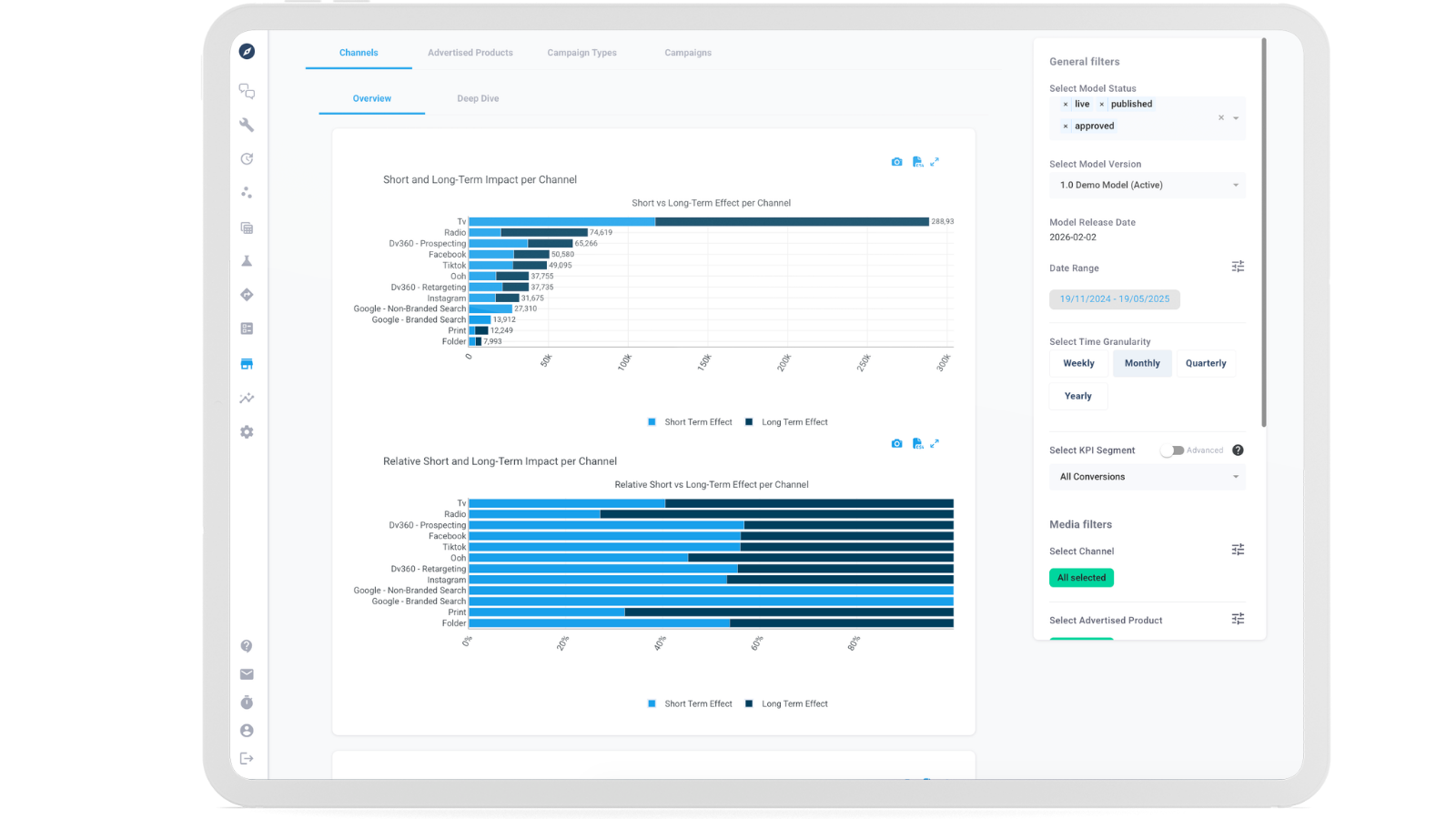
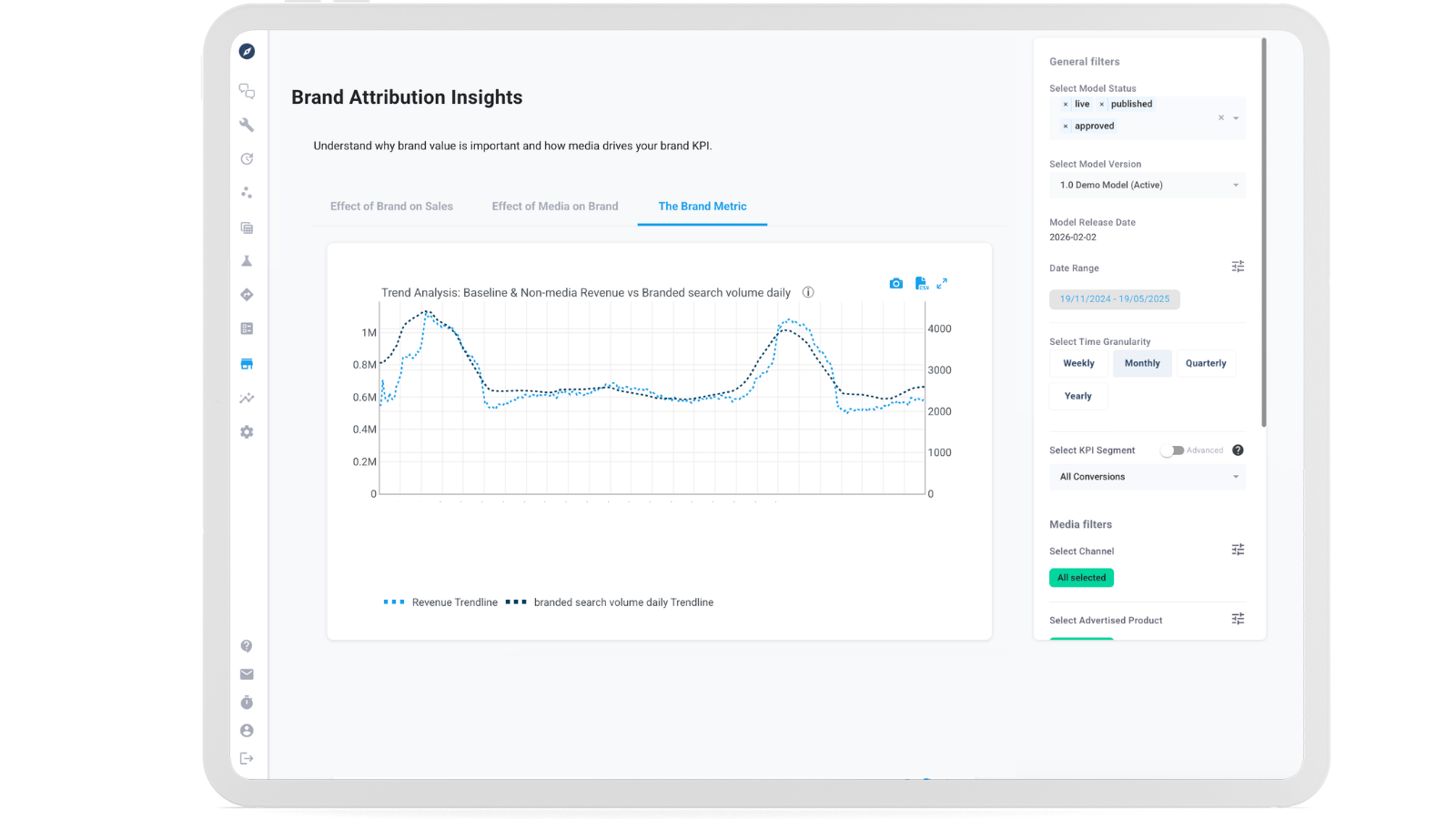
This is where Objective Platform helps. Brand Insights brings brand health metrics together with performance data in one view, so Share of Search sits alongside the channels and campaigns driving it rather than in isolation. Within Brand Insights, Brand Attribution Insights shows how brand strength feeds into performance, while the Short and Long-term Effects view separates the immediate response to media from the slower brand building that Share of Search helps you track.
From there, the Media Scenario Planner lets you test how budget shifts are likely to affect both brand and performance outcomes before you commit, and Oppie can surface where your attention is best spent. This connects brand health to media budget allocation, so you can prove the value of brand work and grow it over time.
What is Share of Search?
Share of Search is a brand health metric that measures the organic searches for your brand as a proportion of all brand searches in your category. It uses free Google Trends data and acts as a fast, low-cost signal of where your brand stands relative to competitors.
How do you calculate Share of Search?
You divide the total organic searches for your brand by the total searches for all brands in the same category over the same period. The result is a percentage that shows how much of the category's search demand your brand commands.
What is the difference between Share of Search and Share of Voice?
Share of Voice measures your brand's share of advertising presence, traditionally weighted towards channels like TV and radio. Share of Search measures actual search behaviour across digital and traditional audiences. Where Share of Voice reflects what you put into the market, Share of Search reflects how people respond to it.
Is Share of Search a reliable predictor of market share?
Research by Les Binet found that Share of Search correlates with market share and works as a leading indicator, in some categories giving up to a year of advance warning. Later research by James Hankins found it accounted for around 83% of market share across 30 case studies, which supports its use as a practical proxy.
Where do you get Share of Search data?
The data comes from Google Trends, which is free to access, available at weekly frequency and stretches back to 2004. This makes Share of Search far quicker and cheaper to track than traditional brand surveys.
How can you use Share of Search to allocate budget?
On its own Share of Search is a signal, not an action. Connecting it to performance data lets you see which channels drive brand interest and test how budget shifts affect both brand and performance outcomes, so brand investment can be planned and defended with evidence.