.png)
Branded search consistently appears close to the conversion point, which gives it a high attribution value in most measurement approaches. The more important question is whether it is generating new demand or capturing interest that was already created by upper-funnel channels like TV, online video and radio. A two-stage nested model separates the direct impact of each channel from the indirect impact it has via branded search, giving a more accurate picture of where incremental value is actually coming from. Getting this attribution right changes how budgets should be allocated across upper and lower funnel channels.
Search plays a significant role in online marketing because of its proximity to conversion. When someone types a brand name into a search engine, the intent signal is strong and the likelihood of purchase is high. This is why branded search consistently attracts high attribution values in most measurement frameworks.
But a more important question sits behind that attribution: are people searching for your brand because they genuinely want it, or are they responding to advertising and brand exposure they encountered elsewhere? The distinction matters because it changes how much credit branded search deserves and, by extension, how your media budget should be allocated.
The debate comes down to whether branded search is creating demand or capturing interest that was already generated by upper-funnel channels like TV, online video and radio. Standard attribution models tend to reward the channel closest to conversion. The question is whether that reward accurately reflects incremental value.
.png)
In most attribution approaches, all cross-media channels are measured as separate contributors to sales. Branded search, TV, online video, display and radio each receive a share of credit based on their observed relationship with conversions. This means that brand-building channels are directly competing with performance channels for attribution credit, even though they operate very differently.
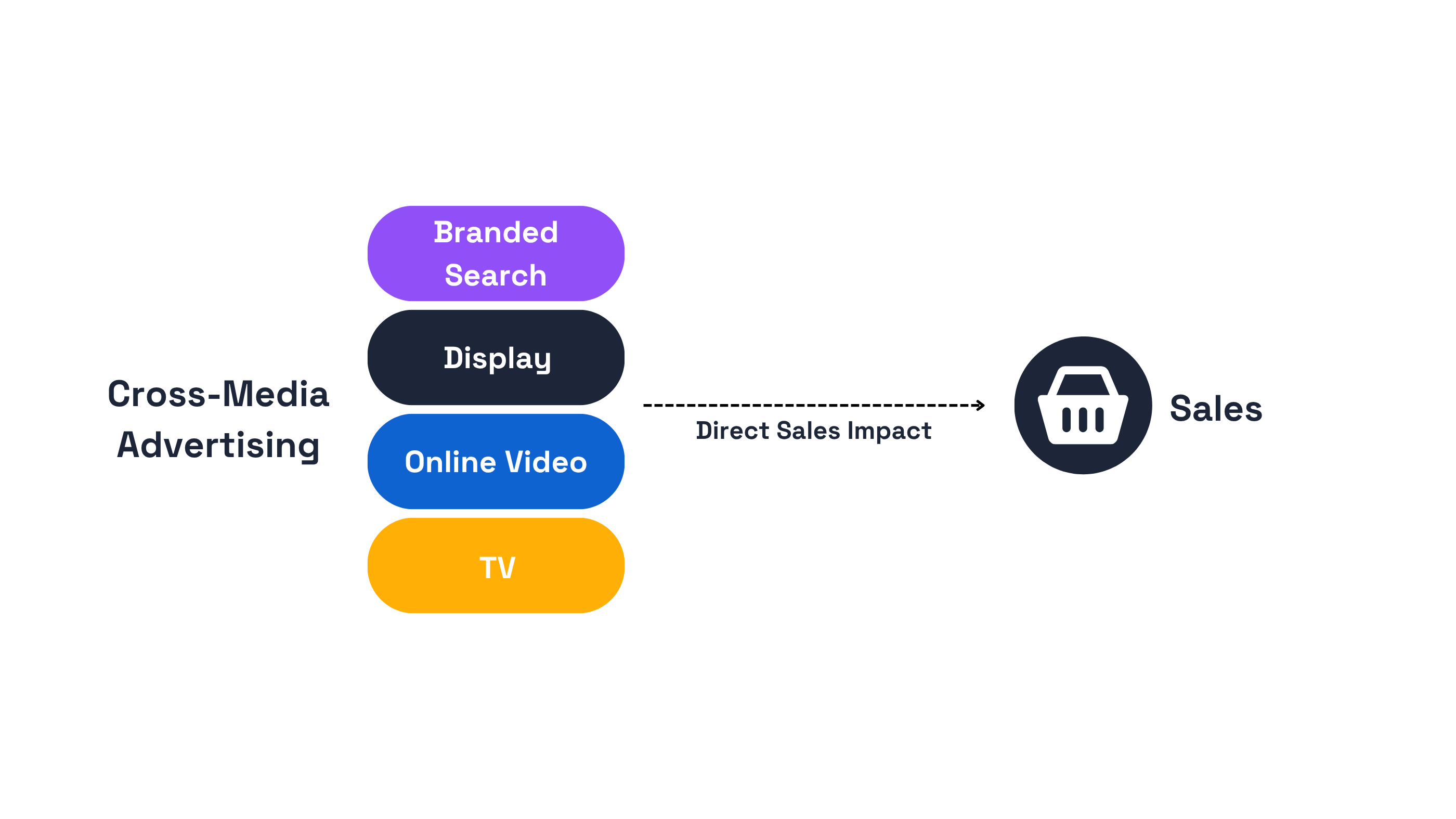
The problem with this approach is that it misses a crucial dynamic. Upper-funnel channels like TV and online video do not only drive sales directly. They also increase branded search queries by building awareness and consideration. When someone sees a TV campaign and later searches for that brand, standard attribution gives the credit to branded search while TV receives little or none. The indirect contribution of the upper-funnel channel is invisible.
.png)
The result is a distorted attribution where the incremental value of brand-building channels is systematically understated and the incremental value of branded search is systematically overstated. Budget decisions based on this picture tend to favour performance channels at the expense of brand investment, which over time depletes the brand consideration that was generating the branded search queries in the first place.
At Objective Platform, we developed a two-stage nested model that addresses this distortion by measuring both the direct and indirect impact of each channel in a single framework.
The model works in two stages. In the first stage, the direct impact of each cross-media channel on sales is measured alongside the impact of branded search. In the second stage, the model measures the effect of upper-funnel channels on branded search volume itself. This makes the indirect path visible: TV drives branded search, which drives conversions, and the TV campaign receives credit for both the direct sales impact and the indirect contribution via branded search.
.png)
The nested model allows us to distinguish between two distinct contributions for each upper-funnel channel: the direct effect on sales and the indirect effect via increased branded search activity. This distinction is what makes media investment decisions more accurate. A TV campaign that appears to have modest direct ROI may in fact be generating a significant proportion of the branded search volume that is driving conversions — and without the nested model, that contribution is invisible.
Understanding the true incremental value of branded search has direct implications for how budgets should be allocated across upper and lower funnel channels.
If branded search is primarily capturing demand that was already created by TV, online video and radio, then cutting upper-funnel investment will eventually reduce branded search volume — and with it, the conversions that branded search appears to be generating. The performance metrics may look stable in the short term, but the pipeline is quietly depleting.
Conversely, if attribution correctly accounts for the indirect contribution of upper-funnel channels, the ROI case for brand-building investment becomes significantly stronger. Channels that appeared to underperform in standard attribution reveal their true contribution when the nested model is applied.
This is also why branded search campaigns should be evaluated in the context of the full media mix rather than in isolation. A branded search campaign running without sufficient upper-funnel support is essentially harvesting a finite pool of existing brand awareness. The results look good until the pool runs dry.
For a practical guide to how experiments can be used to validate these channel relationships before committing budget, see How to Use Experiments in Marketing Measurement. For a broader view of how brand consideration levels affect performance media efficiency, see 5 Reasons Why You Need to Measure Your Brand Health.
What is branded search and why does it matter for attribution?
Branded search refers to search queries that include a specific brand name, such as searching directly for a company or product by name. It matters for attribution because it consistently appears close to the conversion point, giving it a strong association with sales. The attribution challenge is that branded search volume is partly generated by other marketing activity, meaning the credit it receives may overstate its independent contribution to new demand.
Does branded search drive demand or capture existing interest?
In most cases, branded search does both. Some branded search queries represent genuine unprompted demand from people already familiar with the brand. Others represent captured intent, where upper-funnel channels like TV, online video or radio triggered the brand awareness that led to the search query. Standard attribution models cannot easily distinguish between the two. A two-stage nested model separates the direct contribution of branded search from the indirect contribution of the channels that generated the search query in the first place.
What is a two-stage nested model in marketing attribution?
A two-stage nested model is an attribution approach that measures both the direct impact of each channel on sales and the indirect impact of upper-funnel channels via their effect on branded search volume. By nesting the branded search model within the broader media attribution model, it becomes possible to credit upper-funnel channels for the downstream branded search activity they generate, producing a more accurate picture of incremental value across the full media mix.
How does branded search attribution affect budget allocation?
If branded search receives more credit than it deserves because its attribution model does not account for the upstream channels that generated the search query, budget tends to flow towards performance channels at the expense of brand-building investment. Over time, this reduces brand awareness and consideration, which reduces branded search volume, which reduces the conversions that branded search was appearing to generate. Accurate attribution prevents this cycle by giving upper-funnel channels credit for their full contribution, including the indirect path via branded search.
How can I validate the relationship between upper-funnel media and branded search?
Geo-based experiments are one of the most practical ways to validate this relationship. By running upper-funnel activity in some geographic regions while holding others constant, it is possible to observe whether branded search volume increases in the regions that received upper-funnel exposure. The results can then be used to calibrate the nested model and improve attribution accuracy. For a practical guide to this approach, see Validating Marketing Assumptions with Geo-Lift: Branded Search in Focus.