.png)
Third-party cookies have been restricted by Safari and Firefox for years and while Google reversed its plan to deprecate them in Chrome, the direction of travel is clear: measurement approaches that depend on individual-level tracking are becoming less reliable over time. Building a measurement strategy that works without cookies is no longer a future-proofing exercise, it is a practical necessity. Marketing Mix Modelling is one of the most robust approaches available because it operates at an aggregate level and requires no individual user data to produce accurate results.
For the past decades, marketers have been relying on cookies to measure the success of their marketing activities. In this way, they were able to calculate and enjoy a bigger Return On Investment. Privacy regulation and browser-level restrictions have fundamentally changed what data marketers can rely on. This guide covers what has changed, what it means for measurement and how to build an approach that holds up regardless of what happens next with third-party cookies.
In this article, you will find:
The term "cookieless" describes a digital world, where third-party cookies become unavailable to marketers and other industries of interest. This is the result of data privacy regulations imposed by several organisations and legislative bodies, such as the European Union. Data privacy laws have materially affected how marketers can track and measure campaign performance, particularly in digital channels. Understanding what has changed and what tools remain available is the starting point for building a more resilient measurement approach.
These two different types of cookies provide separate information and data on internet users. Understanding the difference is essential for understanding their impact on measurement.
First-party cookies are created by the host domain, the exact domain the user is visiting. These types of cookies are created in order to generate a user-friendly experience in the browser. They save information about usernames, passwords, items added to a shopping cart and language preferences. This information cannot be shared with other websites or advertising partners.
Third-party cookies, on the other hand, are primarily focused on user behaviour and track users across sites and devices. They are created by domains the user is not visiting directly and provide details about age, gender and location. They give detailed insights into a user's entire online journey, including visited websites, time spent on pages and purchasing behaviour. This data has historically been used for cross-site tracking, retargeting, ad-serving and frequency capping.
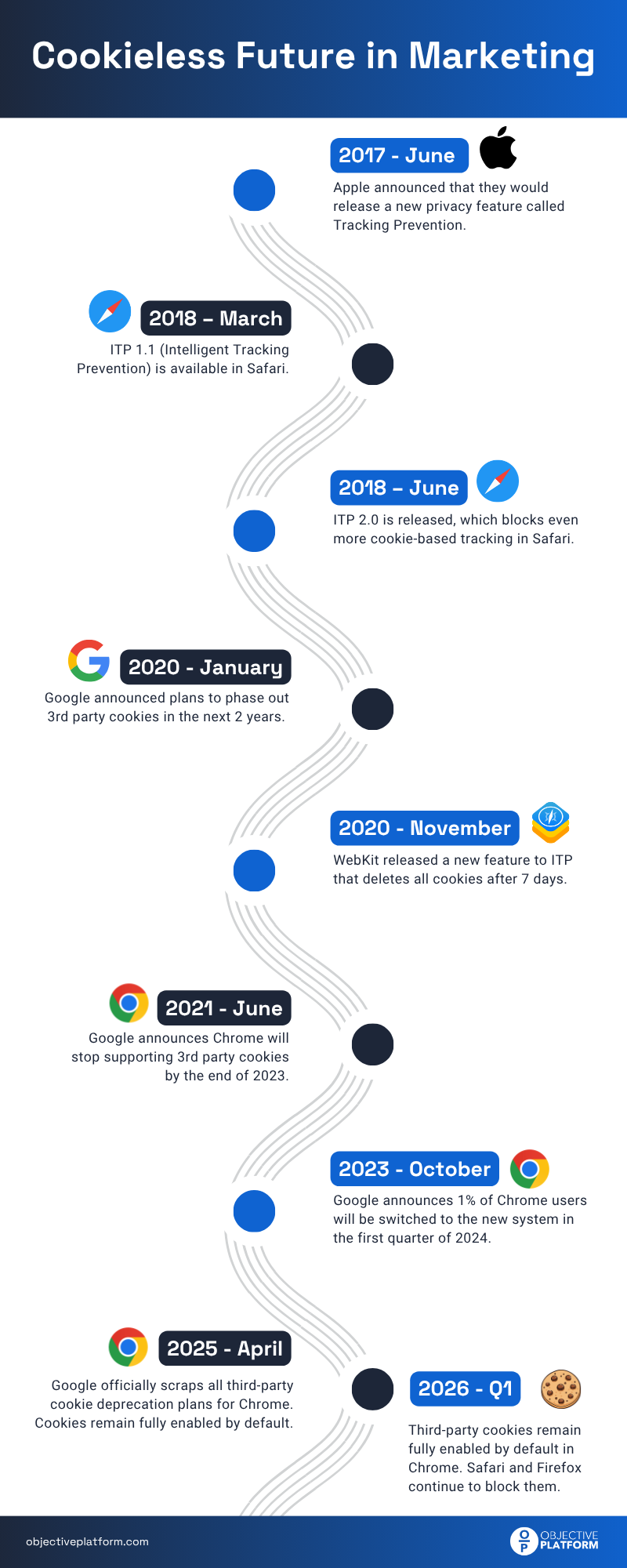
The third-party cookie story has moved through several phases and is still not fully resolved. Here is a concise summary of where things stand. Already in 2017, Safari introduced its first version of Intelligent Tracking Prevention (ITP) to block third-party cookies. After the release of ITP 2.0, third-party cookies were completely blocked in Safari, affecting ad profile building, retargeting and conversion tracking. In 2020, Google announced plans to phase out third-party cookies in Chrome within two years, citing privacy concerns. This triggered significant industry-wide preparation for a cookieless measurement landscape.
In 2024, Google reversed its decision to deprecate third-party cookies in Chrome, citing the complexity of aligning the industry, regulators and developers around an alternative. Third-party cookies therefore remain available in Chrome for now. However, Safari and Firefox continue to block them by default and regulatory pressure on data collection is not easing. The practical effect is that a significant and growing portion of web traffic is already operating without third-party cookie data, regardless of what Chrome does next.
In recent decades, digital marketing has been built around user behaviour data. Tracking via third-party cookies allowed marketers to deliver targeted messages to specific users across sites and devices. Restrictions on that data create real constraints on how campaigns are planned, targeted and measured.
.png)
In a cookieless environment, advertisers lose the ability to track users across channels. This means they no longer have access to behavioural data such as website visits, interests and purchase history across sites. When browsers limit sensitive data collection, audience targeting and frequency capping become harder to execute accurately. Micro-targeted advertising becomes less precise. The biggest complication is for marketing measurement. Specifically, the ability of marketers to measure the impact of their marketing activities and the attribution models they use. With consumers opting out of personalised advertising and browsers limiting tracking, Multi-Touch Attribution (MTA) will decrease in accuracy over time.
The measurement models that hold up best in this environment are those that do not depend on individual-level tracking. Marketing Mix Modelling operates at an aggregate level, using historical data across channels to measure contribution without requiring any user-level data. Combined with incrementality experiments and first-party data, it provides a robust measurement foundation that does not rely on third-party cookies at any point.
One of the main challenges of modern marketing is measurement in a world of restricted data. Here are four practical steps:
No matter how complex the developments are, staying informed is essential. Make sure you understand the available solutions and their limitations. Assess every step you take and align your marketing teams to the developments one step at a time to avoid confusion. The sooner you begin adapting your approach, the easier the transition will be. Organisations that invest in privacy-resilient measurement now will be better positioned when restrictions tighten further, regardless of what any single browser decides to do.
Current marketing measurement tools may fall short as data restrictions increase. Audit your technology and make sure it is built for a future with less individual-level data. If you use Multi-Touch Attribution (MTA), consider how dependent it is on third-party cookie data and what its accuracy looks like as that data becomes less available. More importantly, understand how each tool in your stack processes user-level data and how relevant it will remain as restrictions increase.
Third-party cookies are still available in Chrome for now. Use this period to build a first-party data foundation for your brand and create a reference dataset you can draw on later. Use Multi-Touch Attribution while you can. Design and run experiments to understand how your campaigns perform across different target groups and device settings. Another way to compensate for limited data availability is to incorporate other kinds of data into your measurement model, including factors like seasonality, prior business knowledge and market events. These are the inputs that make next-generation MMM more accurate and more resilient than traditional attribution approaches.
Even where cross-device and cross-platform tracking is limited, brands can use channel-level data to build a broader picture of performance. The challenge is that the same sale is often claimed by more than one channel, leaving you with attributed totals that exceed actual sales.
The solution is a unified measurement framework that evaluates all channels against a consistent methodology. Unified Marketing Measurement (UMM) combines Marketing Mix Modelling, Multi-Touch Attribution, experiments and direct response modelling into a single source of truth. It provides a holistic view of media performance while maintaining as much granularity as possible.
For a broader view of how measurement approaches compare, see our guide to marketing mix modelling solutions.
The cookie debate is unlikely to be fully resolved any time soon. What is clear is that the direction of travel favours measurement approaches that do not depend on individual-level tracking. Investing in MMM, first-party data infrastructure and incrementality testing now gives you a measurement foundation that holds up regardless of how browser policies evolve.
If you want to understand how Objective Platform can help you measure marketing impact without relying on cookie-based attribution, get in touch with our team.
What is cookieless measurement?
Cookieless measurement refers to marketing analytics approaches that do not rely on third-party cookies to track user behaviour. These include Marketing Mix Modelling, incrementality experiments, first-party data strategies and unified measurement frameworks. They produce reliable results regardless of browser-level cookie restrictions.
How does MMM work without cookies?
Marketing Mix Modelling analyses aggregate data across channels, time periods and external factors to measure the contribution of each marketing activity to business outcomes. Because it works at a population level rather than tracking individual users, it does not require cookies or any individual-level data at any point in the process.
What replaces third-party cookies for attribution?
Several approaches can compensate for the loss of third-party cookie data, including first-party data collection, contextual targeting, incrementality experiments and Marketing Mix Modelling. Most organisations are moving towards a combination of these rather than a single replacement, using MMM for strategic budget decisions and first-party data for channel-level optimisation.
Does Google still plan to remove third-party cookies from Chrome?
No. Google reversed its original deprecation plan in July 2024 and then in April 2025 confirmed it would not introduce a user choice prompt either. Third-party cookies remain fully enabled by default in Chrome. However, Safari and Firefox continue to block them, and regulatory pressure on data collection is increasing. Building measurement approaches that do not depend on third-party cookies remains a sound long-term strategy.