.png)
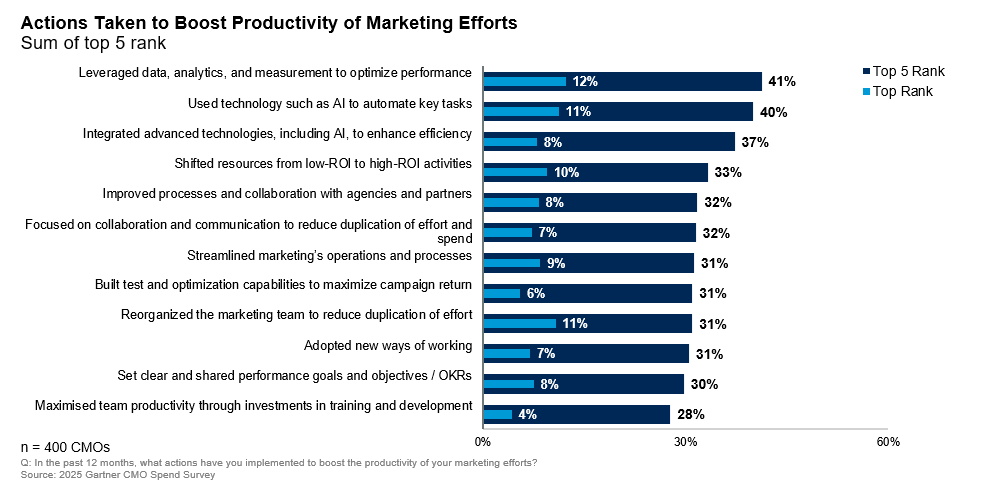
Marketing budgets have flatlined. According to the Gartner 2025 CMO Spend Survey, average marketing budgets sit at 7.7% of company revenue for the second consecutive year, and 59% of CMOs report they have insufficient budget to execute their full strategy. In response, CMOs are looking for ways to do more with the same resources. The same survey found that leveraging data, analytics and measurement to optimise performance was the top action taken to boost marketing productivity, cited by 12% of respondents — ahead of AI adoption, process improvement and agency collaboration. Read the full findings here.
Yet for many CMOs, acting on that priority is easier said than done. Large organisations with extensive marketing activities across online and offline channels face real structural challenges in getting a clear, reliable view of what is working and what is not. At Objective Platform, we work with CMOs across FMCG, Telco, Energy and Automotive to address exactly these challenges. Below are the five we see most often — and how to tackle each one.
Demonstrating that your marketing spend contributes to business success can be genuinely difficult. Impressions, clicks and reach are insufficient proof to convince the CEO, CFO or any other decision-maker that your strategy impacts revenue, ROI, shareholder value and brand equity.
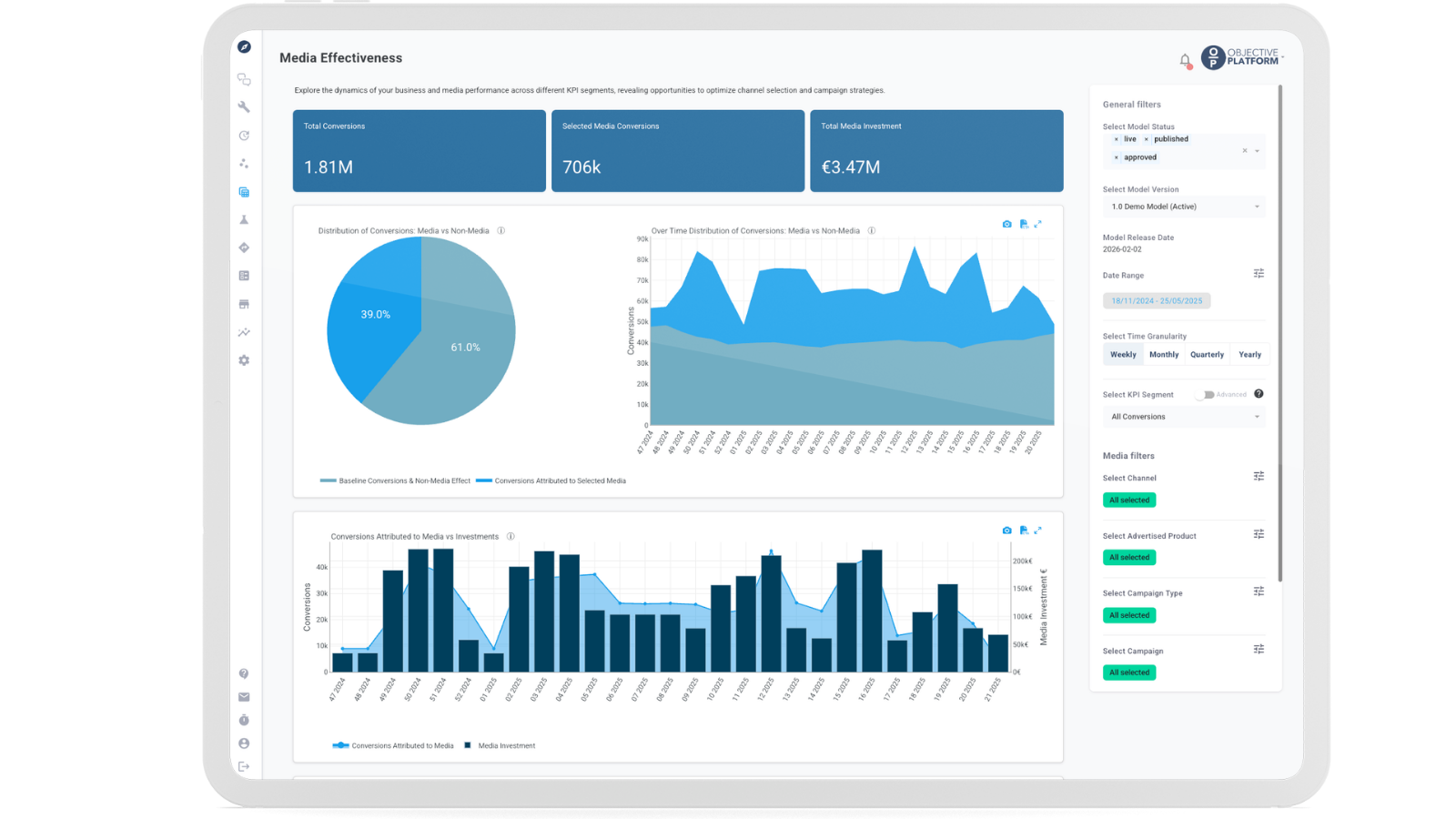
Objective Platform addresses this by creating a single source of truth where all activities — both online and offline — and their results are gathered in one place. Our dashboards provide independent insights into the performance of all activities, where you can see, for example, campaign progress over time, attributed value by channel and efficiency benchmarks across your full media mix.
.png)
This enables CMOs to speak the language of business, providing concrete evidence of each campaign's contribution to short and long-term goals. For a practical breakdown of how incremental ROAS can strengthen the ROI case in CFO conversations, see Incremental ROAS: Why Average ROAS Misleads and How to Fix It.
Consumers rarely move directly from the awareness to the purchase stage. Their journey spans both online and offline channels, and CMOs need to identify the key channels that drive conversion at each stage. A holistic overview is therefore essential. A multichannel retailer we worked with achieved a significant revenue increase by starting its awareness TV advertising two weeks before launching sales-focused online ads. The sequencing of channels — not just the investment level — drove the improvement.
In Objective Platform, you can compare and contrast the effectiveness of various channels. You can measure Facebook versus Instagram, or TV versus Paid Search, and understand how each contributes across the funnel. Using our Media Scenario Planner, you can develop a forward-looking plan based on forecasts, ensuring that your budget allocation is focused on the most effective channels throughout the customer journey.
When it comes to budget cuts, you can make evidence-based decisions by accounting for all factors that might influence a campaign — including external factors like seasonality and pricing — so you know exactly what is and is not working before you cut.
“The fact that we can look at our performance across the funnel and different touchpoints enables us to optimise our strategy and media spend – anytime and anywhere.” – Joris Steenvoorden, Media Manager at T-Mobile
For a practical guide to managing the balance between brand and performance investment across channels, see Brand and Performance Marketing: How to Balance Both Without Sacrificing Either.
Hundreds of measurement tools are available today, each with extensive capabilities. One of the main challenges CMOs face is selecting the right technology — tools that save time, reduce manual effort and provide the most relevant insights for decision-making.
Selecting the wrong platform creates its own problems: fragmented data, conflicting attribution outputs and a measurement stack that requires significant internal resources to maintain without producing the strategic clarity the CMO needs.
As part of our solution, Objective Platform has developed a data layer that automatically gathers, validates and restructures your data from more than 200 sources. This is the first step towards a holistic view of key metrics across both offline and online channels. Automating this process removes the need to manually connect data sources, ensuring a continuous flow of high-quality data ready for modelling. This reduces the time to insights and ensures decisions are always based on the latest available information.
Privacy regulations have fundamentally changed how marketing data can be collected, stored and used. GDPR in Europe and similar frameworks globally restrict the use of individual user-level data, and tracking capabilities vary significantly across browsers — Safari and Firefox block third-party cookies, while Chrome has maintained them but faces ongoing regulatory scrutiny.
For CMOs, this creates a measurement challenge: how do you maintain sufficient insight into marketing effectiveness when individual user tracking is increasingly restricted?
Marketing Mix Modelling addresses this directly. Because MMM operates on aggregated historical data rather than individual user tracking, it is privacy-safe by design. It does not require third-party cookies to function and remains fully effective regardless of browser restrictions or changes to tracking policy.
At Objective Platform, historical performance data is securely stored and continuously updated, meaning your model does not lose accuracy as tracking restrictions evolve. Your measurement capability grows over time rather than being disrupted by regulatory change — a meaningful advantage when privacy requirements are becoming more stringent, not less.
Implementing a measurement platform alone will not improve your KPIs. Effective marketing measurement requires organisational change alongside the right tools. That means breaking down team silos as well as data silos, aligning finance and marketing around shared metrics and building internal credibility for measurement outputs at every level of the organisation.
In practice, this involves identifying key stakeholders — the CFO, the Head of Media, the Head of Data Analytics — and ensuring they understand and trust the measurement methodology. A white-box platform, where every variable and assumption is inspectable, makes this significantly easier. Stakeholders who can see how a model reaches its conclusions are far more likely to act on its outputs than those who are asked to trust a black box.
It also involves embedding experimentation into the measurement workflow. Geo-lift tests and A/B experiments generate causal evidence that calibrates and validates the model over time, building confidence in the outputs and creating a feedback loop between measurement and decision-making. CMOs who invest in measurement culture — not just measurement tools — build a capability that compounds in value year on year.
For a practical guide to building measurement credibility through experimentation, see When Your Attribution Model Is Wrong: What to Do Next.
Marketing budget control is not just about spending less — it is about spending with confidence. CMOs who can demonstrate the incremental value of each channel, defend their brand investment with hard data and present forward-looking scenarios to the Board are in a fundamentally stronger position than those who rely on platform-reported metrics or agency-produced numbers.
The five challenges above are not solved by any single tool or methodology. They require a measurement approach that is independent, transparent, always on and connected to business outcomes — and a leadership commitment to act on what the data shows.
If you would like to understand how Objective Platform can help your organisation take control of its marketing budget, get in touch with our team.
Why is marketing budget allocation so difficult for CMOs?
Marketing budget allocation is difficult because the relationship between spend and outcome is rarely direct or immediate. Different channels work on different timescales, external factors like seasonality and competitor activity affect results and most measurement tools only capture part of the picture. Without a unified view of all channels and factors, CMOs are forced to make allocation decisions based on incomplete evidence — often favouring channels that look efficient in platform reporting but may not be delivering the best incremental return.
How does Marketing Mix Modelling help CMOs justify marketing spend?
Marketing Mix Modelling measures the contribution of all marketing and non-marketing factors to business outcomes using aggregated historical data. It produces channel-level ROI figures that are independent of agency reporting, account for external factors and can be explained in terms the CFO understands. This gives CMOs a defensible evidence base for budget decisions rather than relying on metrics that only reflect part of the customer journey.
What is the difference between a single source of truth and a standard analytics dashboard?
A standard analytics dashboard shows performance data from individual platforms — Meta, Google, TV ratings — in one place, but each data source uses its own attribution methodology. A single source of truth applies one consistent measurement model across all channels and external factors, producing a unified view of marketing contribution that is not distorted by platform-level reporting biases or conflicting attribution rules.
How can CMOs make better budget decisions when trading conditions are difficult?
When budgets are under pressure, the risk of cutting the wrong thing is high. CMOs who have a clear view of which channels are driving incremental revenue versus which are capturing demand that would have occurred regardless are in a much better position to make targeted cuts that protect business outcomes. Marketing Mix Modelling, and specifically the Media Scenario Planner within Objective Platform, allows CMOs to model the revenue impact of different budget scenarios before committing to cuts.
How does Objective Platform protect marketing measurement under privacy regulations?
Objective Platform operates on aggregated historical data rather than individual user tracking, making it privacy-safe by design. It does not require third-party cookies to function and remains effective regardless of browser restrictions or changes to tracking policy. Historical performance data is securely stored and continuously updated, ensuring measurement accuracy improves over time rather than degrading as privacy regulations tighten.