.png)
Balancing brand and performance marketing is not a one-time budget decision. It requires ongoing measurement to stay calibrated as market conditions change. Brand campaigns and performance campaigns work on different timescales, but they are not independent: brand strength directly affects how efficiently performance media converts. Channels like TV and always-on activity are disproportionately effective at building the brand consideration that makes performance campaigns cheaper to run. Understanding which channels drive long-term versus short-term effects in your specific mix is the starting point for getting the balance right.
Most marketing teams understand the theory. Brand investment builds the conditions for sustainable growth. Performance campaigns convert the demand that brand activity creates. The two work together.
The difficulty is that they operate on different timescales, which makes them hard to weigh against each other when budget decisions need to be made quickly. Performance campaigns show results within days or weeks. Brand campaigns often take months to influence baseline sales. In a planning cycle under pressure, the measurable channel tends to win.
This dynamic leads many organisations to gradually shift budget towards performance over time, often without a deliberate decision to do so. The short-term numbers look fine. What gets harder to see is the slow erosion of the brand consideration that was making those performance campaigns efficient in the first place.

The relationship between brand and performance is not just directional. It is quantifiable. Brand consideration levels act as a multiplier on how efficiently your performance media converts.
When brand consideration is high, consumers are already predisposed towards your brand before they see a performance ad. Click-through rates improve, cost per acquisition falls and the same media budget generates more conversions. When brand consideration drops below a critical threshold, performance campaigns work against a headwind. You are paying to convert audiences who have not been sufficiently warmed up by brand activity.
This is why finding your brand's tipping point matters. It is the specific brand consideration level at which the multiplier on base performance turns positive. Below it, each euro spent on performance media generates fewer conversions. Above it, campaigns become more efficient. We covered how to identify this tipping point in detail in Brand vs Performance Marketing: How to Find the Right Investment Split, including a worked example using real data from the Objective Platform Brand Insights module.
.png)
Balancing brand and performance starts with understanding what your current channel mix is actually doing. Not all channels contribute equally to short and long-term outcomes, and the split is often different from what teams assume.
In the Objective Platform Short and Long-term Effects dashboard, you can see the breakdown of conversions by channel across both timescales. TV and radio, for example, are disproportionately long-term in their impact. Digital performance channels like retargeting and branded search skew heavily short-term. Neither is better in isolation. The question is whether your current mix reflects the balance your brand needs.
A media mix heavily weighted towards short-term channels may be generating strong immediate results while quietly depleting the brand consideration that sustains them. Conversely, a mix with significant offline brand investment but without enough short-term activation may be building awareness without converting it efficiently.
The starting point is making the short and long-term contribution of each channel visible, so budget decisions are based on the actual split rather than assumptions about what each channel type does.
.png)
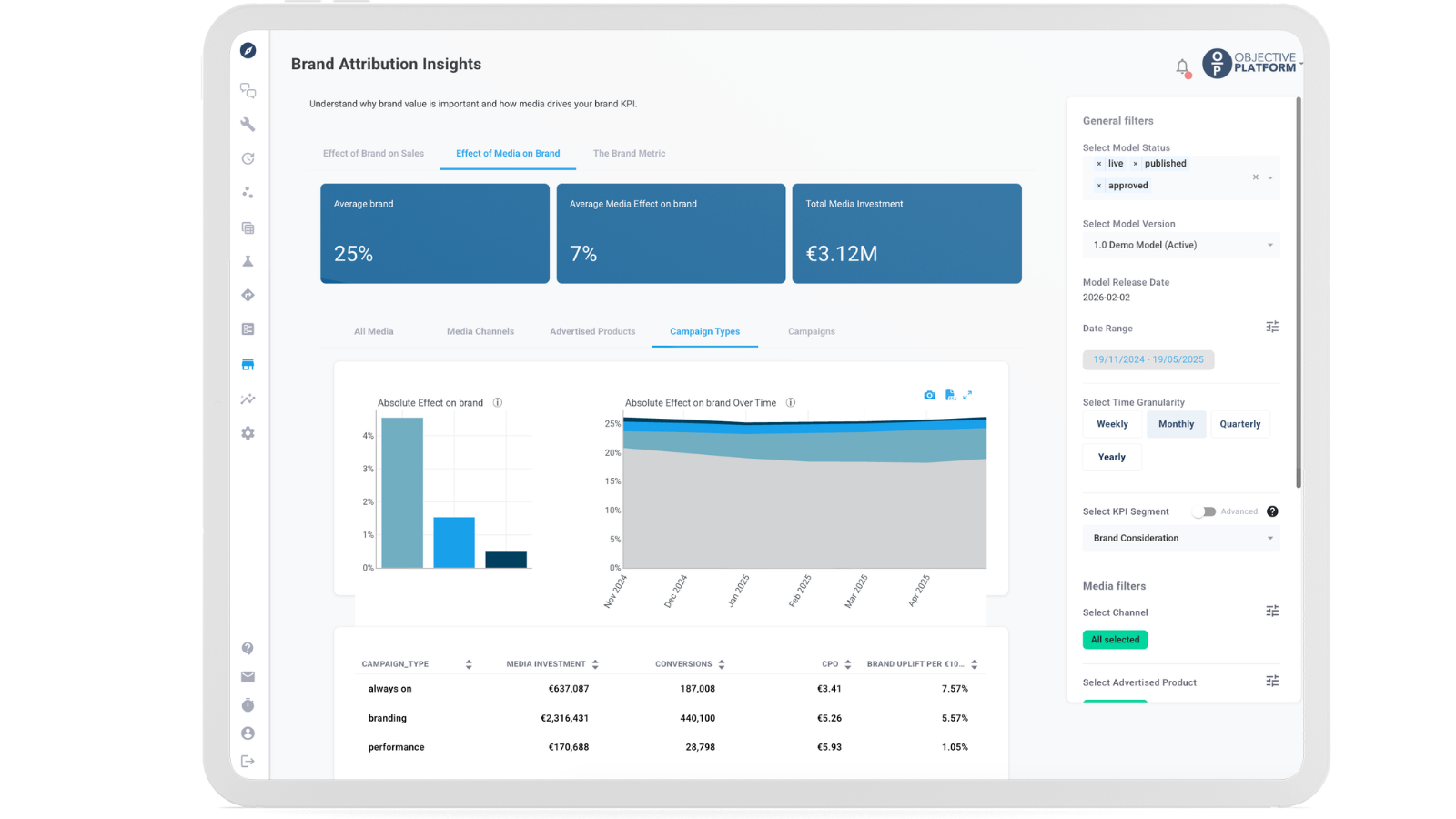
Beyond channel, campaign type is worth examining separately when thinking about brand consideration. Different campaign types contribute to brand metrics at different rates, and the breakdown is not always what teams expect.
Looking at brand uplift per €100k invested by campaign type can reveal meaningful differences between always-on activity, dedicated branding campaigns and performance campaigns. In the worked example from our Brand Insights module, always-on campaigns delivered the highest brand uplift per €100k invested, while performance campaigns contributed the least. The gap between them was significant enough to change how the team thought about maintaining brand consideration between larger campaign flights.
Your own data may tell a different story. The relative efficiency of each campaign type depends on your category, your audience and how your media mix is structured. What the analysis consistently reveals, however, is that the contribution of each campaign type to brand metrics is rarely proportional to its share of budget. Understanding that relationship for your specific brand is what allows you to make deliberate decisions about where to direct spend when brand consideration needs to move.
Getting the balance right is an ongoing process, not a single budget allocation decision. A few principles help keep it on track.
First, establish your brand's tipping point. Without knowing the specific brand consideration level at which your performance media starts working more or less efficiently, any split you choose is a guess. Marketing Mix Modelling, and specifically the Brand Insights module within Objective Platform, gives you this number based on your own historical data. For a practical breakdown of how incremental ROAS can guide budget decisions across channels, see How to Properly Use ROAS to Optimise Advertisement Budget.
Second, monitor brand consideration as a leading indicator alongside performance metrics. If brand consideration is falling, performance CPO is likely to rise in the coming weeks or months, even if you cannot see it yet in campaign dashboards. Treating brand KPIs as forward-looking performance signals rather than separate brand objectives changes how budget conversations happen.
Third, use always-on activity to maintain brand consideration between campaign peaks. Large brand campaign flights move the needle, but always-on activity at a consistent level is what keeps consideration above the threshold. The two work together: big flights to build, always-on to hold.
Finally, review the long and short-term split in your channel mix at least once per planning cycle. Channel effectiveness changes over time as audiences, platforms and competitive dynamics shift. A split that was right twelve months ago may need rebalancing. How to Use Experiments in Marketing Measurement covers how to validate these assumptions with structured tests before committing budget.
How do you balance brand and performance marketing budgets?
Start by understanding the relationship between your brand KPIs and your media performance outcomes. The right split depends on your brand's current consideration level, your competitive position and how efficiently your performance media is converting. A useful starting point is the 60/40 rule from Binet and Field, but the most reliable approach is to measure your own brand's tipping point and allocate accordingly.
What happens if you invest too much in performance marketing?
Over-indexing on performance at the expense of brand investment gradually depletes brand consideration. As consideration falls, performance media becomes less efficient: cost per acquisition rises and conversion rates decline. The effect is slow to appear in campaign dashboards, which is why it often goes unnoticed until the damage is significant.
What is always-on marketing and why does it matter for brand building?
Always-on marketing refers to continuous, lower-intensity campaign activity that runs between larger campaign flights. It is particularly effective for maintaining brand consideration above the tipping point because it keeps the brand present in market consistently, rather than in concentrated bursts followed by silence. How efficient it is relative to other campaign types will depend on your specific brand and category.
How do you measure the long-term effects of brand campaigns?
Click-based attribution cannot capture long-term brand effects because it only measures direct response to ads. Marketing Mix Modelling separates short and long-term media contributions using historical sales data, making it possible to see how brand investment is influencing baseline sales over time. The Short and Long-term Effects dashboard within Objective Platform breaks this down by channel, campaign type and advertised product.
How often should you review your brand and performance balance?
At minimum, once per annual planning cycle. More frequent reviews, quarterly for example, are useful for brands operating in fast-moving categories or those making significant changes to their media mix. The key trigger for a review is any sustained change in brand consideration, either upward or downward, as this signals a shift in the conditions under which your performance media is operating.