.png)
Click-based attribution only assigns value to touchpoints that generate a click, which means TV, radio, sponsorships and brand activity are systematically ignored. This leads to over-investment in easy-to-measure channels like paid search and retargeting, at the expense of channels that build long-term demand. Marketing Mix Modelling takes a different approach — analysing all marketing activity together using historical data, so every channel gets credit for its actual contribution. The result is a more accurate picture of what's driving growth and a more defensible basis for budget decisions.
Attribution models play a crucial role in decision-making for your business. Many companies still rely on last-click or other click-based attribution because it's simple and convenient. The problem is that simple and convenient is not the same as accurate.
In fact, 78.4% of marketers still use last-click attribution and web analytics to measure media efficacy, even though most know it's flawed. As EMARKETER's vice president of content Paul Verna put it: "[Last-click attribution is] the devil marketers know… It falls well short of representing what's really going on."
Click-based attribution is a method of measuring marketing performance that assigns credit to the touchpoints a user clicked before converting. Depending on the model, that credit goes to the first click, the last click or is distributed across multiple clicks in the journey. The underlying assumption is that if someone clicked on an ad, that ad contributed to the sale. If they did not click, it did not. This makes click-based attribution straightforward to implement and simple to explain to stakeholders, which is largely why it became so widespread. The limitation is that most of what influences a purchase decision never generates a click. A TV ad, a sponsorship, a billboard, a podcast mention – none of these produce a trackable click but all of them can shift brand perception and drive demand.
Click-based attribution models, whether first-click, last-click or multi-touch, only assign value to touchpoints that generate a click. But in today's media reality, most of what influences people never gets clicked. It's like evaluating a football team by only counting the players who score goals. You ignore defenders, midfielders, the keeper, the build-up play and even the coach. Goals matter, but without the rest of the team doing their job, there would be no goals at all. That's the flaw in click-based attribution. It rewards only the visible, clickable actions and ignores everything else that builds demand, mental availability and brand preference.
This leads to poor decisions:
And they know it: 74.5% of marketers are either moving away from last-click attribution or would like to. As one EMARKETER analyst noted, "It doesn't give the full picture of the consumer journey. It over-attributes the effectiveness of that last touchpoint." Clicks are not a measure of contribution. If your model only values what gets clicked, it's not telling the full story.
The channels click-based attribution struggles to account for are often the ones doing the heaviest lifting for brand growth:
The result is a measurement gap that grows larger as media mix becomes more complex.
Marketing Mix Modelling (MMM) provides a more comprehensive approach by analysing historical data and isolating the impact of different marketing activities. Instead of relying on a single touchpoint, MMM considers the entire customer journey across multiple channels.
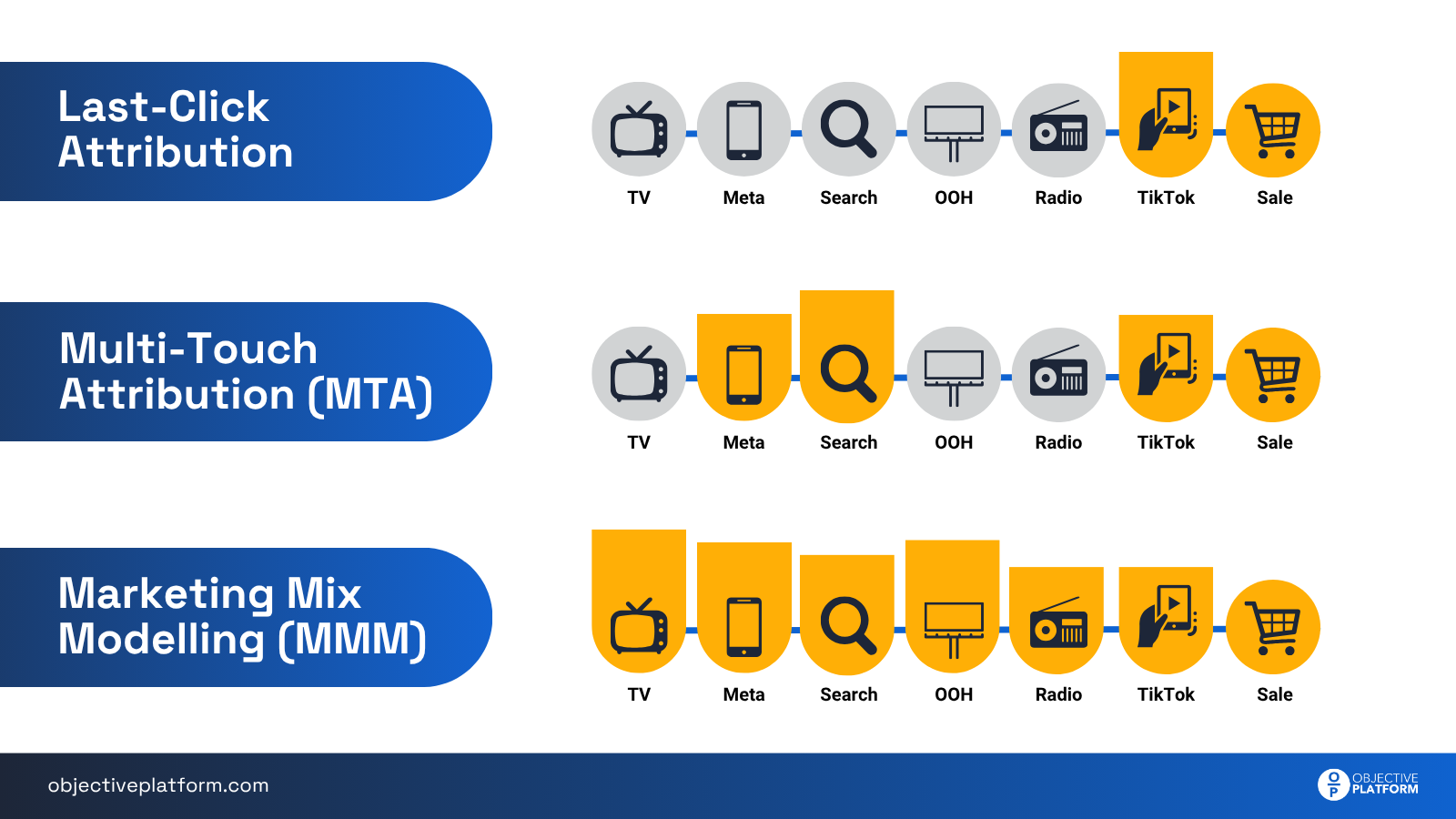
MMM gives marketing teams a measurement foundation that click-based attribution cannot:
For a broader look at how MMM compares to other measurement approaches, see our guide to marketing mix modelling solutions.
The two approaches are not mutually exclusive. Many marketing teams use MMM for strategic planning and budget allocation while using platform attribution for day-to-day campaign management. MMM provides the context that makes platform data more meaningful.
Moving away from click-based attribution does not mean abandoning digital measurement. It means adding a layer of analysis that puts your digital data in context, so you know whether your search campaigns are creating demand or simply capturing it. If you are ready to look beyond click-based attribution and build a measurement approach grounded in actual contribution, get in touch with the Objective Platform team.
What is click-based attribution?
Click-based attribution is a marketing measurement method that assigns credit for a conversion to the ad touchpoints a user clicked before purchasing. Common models include first-click, last-click and multi-touch attribution. The core limitation is that it can only measure channels that generate a click, leaving offline media, brand activity and upper-funnel digital largely unaccounted for.
Why is click-based attribution misleading?
Click-based attribution consistently over-credits the last or most visible touchpoint in a customer journey while ignoring the channels that built demand earlier. This distorts budget decisions, making paid search and retargeting appear more effective than they are, while undervaluing TV, audio and brand activity that drove consumer intent in the first place.
What does MMM measure that click-based attribution misses?
Marketing Mix Modelling accounts for all marketing activity, including offline channels like TV, radio and out-of-home, as well as upper-funnel digital and brand campaigns that do not generate direct clicks. It also captures the effect of external factors like seasonality, pricing and competitor activity — none of which appear in click-based models.
How do I transition from click-based attribution to MMM?
The most practical approach is to run MMM alongside your existing attribution setup rather than replacing it immediately. MMM gives you a strategic view of channel contribution, which you can use to stress-test your attribution data and identify where the biggest gaps are. Over time, MMM outputs can inform budget allocation while platform attribution continues to support day-to-day campaign management.
Can MMM and click-based attribution be used together?
Yes, and for most organisations this is the recommended approach. Click-based attribution provides fast, granular data for tactical optimisation within digital channels. MMM provides the broader context for strategic decisions, including how much to invest across channels and how offline and online activity interact. The two approaches complement each other rather than compete.